
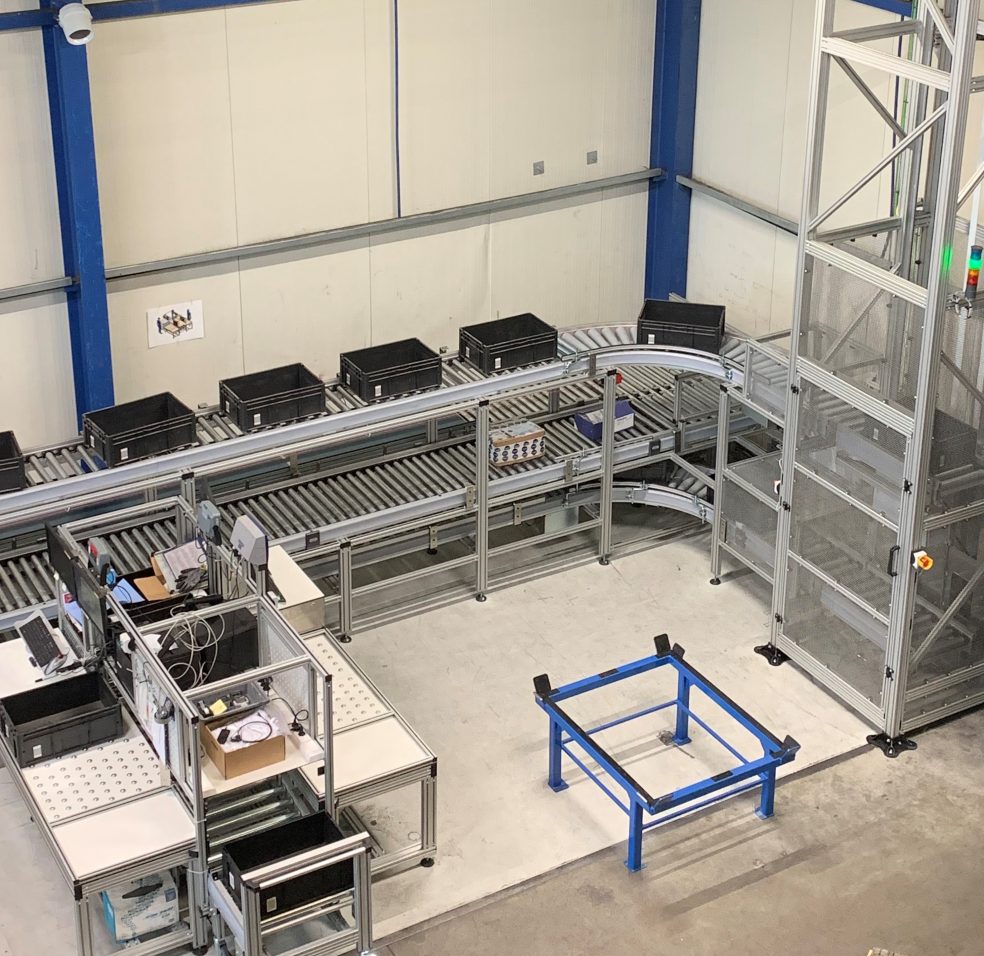
Vandewiele regards change as an opportunity. Therefore, the machine builder adapted its incoming goods systems to the new circumstances: not only grouped shipments on pallets, but large volumes of boxes and packages, delivered throughout the day by all kinds of couriers and express services. In order to receive and store this influx efficiently, Easy Systems installed a completely new reception area at Vandewiele, equipped with a physical link to the automatic mini-load storage facility.
Vandewiele from Marke (Kortrijk) designs and manufactures high-tech machines for the textile industry. In 1921, Michel Van de Wiele transformed an existing machine repair shop – founded in 1880 – into a production workshop for looms. Throughout the one hundred years that followed, Vandewiele gradually grew into a leading player, with production and service centres all over the world. The company continues to focus on innovation, a consistent investment policy and state-of-the-art production facilities, with Vandewiele implementing the entire production process in-house from A to Z. Vandewiele employs 3,000 people worldwide, of which some 750 work at the parent company in Marke.
From pallets to parcels
Vandewiele has been keeping its finger on the pulse of the textile industry for over a hundred years. This is not only reflected in the machines and solutions that the company offers, but also in the way it organises its processes behind the scenes. In Marke, Vandewiele built a large warehouse for parts and spare parts, with not only several stacker warehouses for the larger pieces, but also two automatic mini-load storage facilities: one with 20,000 positions and one with 8,000 positions. “Until recently, the process of receiving goods was perfectly tuned to transporters coming to deliver pallets to us,” explains Thomas Van Esbroeck, Manager Assembly Department at Vandewiele.
However, the transport world has changed so rapidly in recent years that the existing process no longer met the company’s needs. Trucks delivering pallets are no longer the standard. “Parts and spares reach us today in boxes and packages, delivered by couriers and express services,” Thomas Van Esbroeck explains. “They work faster, cheaper and more flexibly than traditional truck transporters. Throughout the day, couriers and parcel companies come and go. Some of the drivers come by here several times a day.” It forced Vandewiele to thoroughly review the incoming goods process. At the same time, the company took the opportunity to examine how it could further streamline and automate the process.
Strict delivery sequence
“The objective was to switch to a paperless approach when receiving parcels, with a failsafe check on the goods and quantities received,” explains Thomas Van Esbroeck. “At the same time, we wanted a process that prevents a received order from getting lost in the warehouse and that also respects the delivery order.” Vandewiele strictly adheres to the principle of ‘first in first out’. Arriving first automatically means being received first, placed in stock first and taken out of stock first. Vandewiele’s aim is to leave no room for interpretation. The warehouse staff cannot choose which goods to process first. They have to respect the delivery order.
“That is why it was not an option to keep the existing pallet-based incoming goods system,” continues Thomas Van Esbroeck. “We could have chosen to bundle the goods that arrive in cardboard boxes onto pallets ourselves and thus further organise the inbound. But that would make it impossible to respect the delivery sequence.”
The company therefore opted for a new receiving process, adapted to the changed transportation market. Vandewiele approached Easy Systems to work out a solution for a new reception system. “At first we were only thinking of a carousel, but the longer we thought about the project, the more possibilities we saw.”
Parcours
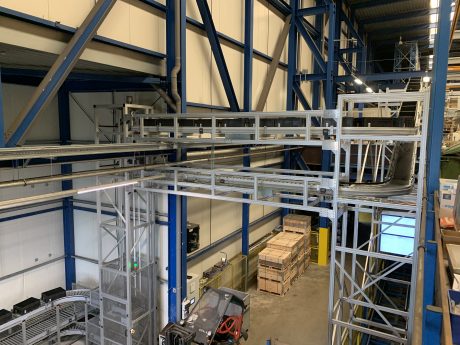
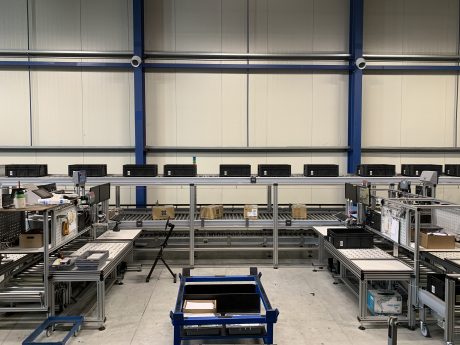
The final result is a new receiving station with four workstations and an automatic link to the largest container warehouse: 20,000 storage locations, distributed in a warehouse 20 metres high and 115 metres long. From start to finish, the boxes follow a track with roller conveyors, carpet belt, a transfer system and a double-acting lift. The entire system is designed for boxes measuring up to 60 by 60 by 50 centimetres and 49 kilograms. In practice, the boxes are usually a lot smaller and weigh no more than 15 kilograms. “Upon arrival, an employee scans the shipment note from the supplier and places the packages in the queue on the roller conveyor,” Thomas Van Esbroeck explains. “Via the roller conveyor the boxes arrive at the workstation in order of receipt. There, the employee takes an empty box – automatically brought in via another roller conveyor – and places it on a height-adjustable work table with built-in scales.” The employee checks the electronic dispatch note against the order form. If everything is correct, the WMS links the goods to the unique number of the container.
The employee then sends the container – via a built-in lift unit in the workstation – to the bottom roller conveyor. A check weighing takes place in between. The maximum permissible load for the lift is 49 kilograms. If the container weighs more, the system automatically sets it aside. If the check weighing is correct, the container takes the lift to the automatic container magazine. While the full container goes up, the double-acting lift brings an empty container to the reception station. “At the container storage, the system automatically drops the container off at the entrance, just as if an employee were doing it manually,” says Thomas Van Esbroeck. It is a special feature of the project. “In this way, Easy Systems succeeded in physically linking the goods receipt with the container warehouse, without the need for integration at the software level.”
For Easy Systems, this also presented a special challenge: after all, the entire installation had to fit within the existing environment, spread over two floors. The result was a fine piece of customisation, carried out with standard components from Easy Systems’ portfolio, including the typical aluminium profiles.
Shorter turnaround time
“In the past, parcels often piled up quickly in the reception area, making it impossible to respect the delivery order,” says Thomas Van Esbroeck. “Today, we keep an overview at all times.” Hence Vandewiele’s decision to provide four workstations at the reception area. One post is manned as standard. However, the extra workstations make it possible to immediately deal with peak moments. There is then no longer any question of piling up unreceived goods. The maximum processing capacity of the reception desk is calculated at 250 boxes per hour. “That is ample. It ensures that we can handle the supply of parcels without problems. We can’t lose any packages and are sure of the ones delivered. We no longer lose time and money trying to find delivered parcels or – in the worst case scenario – re-order them.”
The new approach to goods reception relies not only on the installation of Easy Systems, but also on a piece of digitisation. “We are switching to paperless working, with the reception staff working with digitised dispatch notes.” Currently, Vandewiele is still working with a WMS application that the company developed in-house. In the short term, however, Vandewiele will be transferring its warehouse management to Microsoft Dynamics AX. This should give the digital efficiency in the warehouse an extra boost. The combination of the new installation and the digital component is already resulting in faster reception and storage. “The throughput time has been noticeably reduced. In the past, delivered packages often stayed behind too long. Today, they are available in the container warehouse very quickly after reception.”
Solid basis
The entire company benefits from this speed, as it means that the items are available more quickly in the context of planning, picking and outbound logistics to the production and maintenance teams. In other words: the project demonstrates how efficient goods receipt forms the solid basis for all subsequent steps. “What is important is that with the project we have succeeded in redesigning the entire process by focusing on the combination of automation and digitalisation,” concludes Thomas Van Esbroeck. “The fact that we are now working more efficiently also creates more peace in the department.”
Curious about what we can do for you? Contact us or discover our projects.
Source:https://www.valuechain.be/nl/nieuws/detail/7010/minder-verlies-snellere-inslag